Research Article
The impact of personal, family, and educational environment factors on awareness of professionalism among health science students
Impacto de los factores personales, familiares y del entorno educativo en la conciencia del profesionalismo en estudiantes de ciencias de la salud
Minh Huu Le1 https://orcid.org/0000-0003-2618-9377
Tan Dat Nguyen1 https://orcid.org/0000-0002-6192-603X
Ngoc Huyen Nguyen1 https://orcid.org/0009-0003-1176-9675
Lan Thi Kieu Nguyen1 https://orcid.org/0009-0004-2809-1802
Leo Van Le1 https://orcid.org/0009-0008-9728-2310
Trung Chi Minh Nguyen1 https://orcid.org/0009-0006-2651-0086
Van Trang Do2 https://orcid.org/0000-0002-0885-0216
Tuyen Thi Hong Nguyen1* https://orcid.org/0000-0002-1332-5862
1Can Tho University of Medicine and Pharmacy. Can Tho City, Vietnam.
2Binh Duong Medical College. Ho Chi Minh City, Vietnam.
*Corresponding author. Email: nthtuyen@ctump.edu.vn
ABSTRACT
Background: Awareness of professionalism is essential for students in health sciences, as it supports effective learning, ethical conduct, and professional development, and plays a crucial role in shaping their future careers.
Objective: To assess the impact of personal characteristics, family background, and educational environment factors on awareness of professionalism among health science students.
Methods: A cross-sectional study was conducted at a public medical university in southern Vietnam. A total of 969 students completed an online questionnaire. Awareness of professionalism was measured using the 32-item American Board of Internal Medicine (ABIM) professionalism scale, translated and culturally adapted to Vietnamese. Multiple linear regression analysis was performed to identify factors associated with professionalism awareness.
Results: The mean professionalism score was 3.94. Multivariate analysis showed that higher awareness of professionalism was significantly associated with older age (p = 0.012), male gender (p = 0.013), enrollment in medicine- or pharmacy-related programs (p = 0.038), and having parents working in healthcare or civil service (p = 0.011). In addition, higher satisfaction with the educational environment, particularly alignment of the chosen major with expectations, perceived faculty expertise, and kindness within the learning environment, was strongly associated with greater professionalism awareness (p < 0.001).
Conclusion: Awareness of professionalism among health science students is influenced by personal, family, and educational environment factors, highlighting the need to strengthen professionalism education and supportive learning environments.
Keywords: awareness; health knowledge, attitudes, practice; health personnel; professionalism; students, medical; surveys and questionaries.
RESUMEN
Antecedentes: La conciencia del profesionalismo (CP) es esencial para los estudiantes de ciencias de la salud; apoya el aprendizaje efectivo, la conducta ética y el desarrollo profesional. Es crucial en la formación de sus futuras carreras.
Objetivo: Evaluar el impacto de las características personales, el contexto familiar y los factores del entorno educativo en la CP de los estudiantes de ciencias de la salud.
Métodos: Estudio transversal, en una universidad médica pública del sur de Vietnam, en 969 estudiantes, en quienes se midió la CP con la escala de profesionalismo de la American Board of Internal Medicine (ABIM), traducida y adaptada culturalmente al vietnamita. Se realizó un análisis de regresión lineal múltiple para identificar los factores asociados con la conciencia del profesionalismo.
Resultados: La puntuación media de profesionalismo fue de 3,94. El análisis multivariante mostró que mayor conciencia del profesionalismo se asoció con mayor edad (p= 0,012), sexo masculino (p= 0,013), inscripción en programas de medicina o farmacia (p= 0,038) y padres que trabajen en el sector salud o servicio civil (p= 0,011). Se asoció fuertemente a CP (p< 0,001), mayor satisfacción con el entorno educativo, particularmente la coincidencia de la carrera elegida con las expectativas, la percepción de la experiencia del profesorado y la amabilidad dentro del entorno de aprendizaje.
Conclusión: La CP entre los estudiantes de ciencias de la salud está influenciada por factores personales, familiares y del entorno educativo, lo que destaca la necesidad de fortalecer la educación en profesionalismo y los entornos de aprendizaje de apoyo.
Palabras clave: concienciación; conocimientos, actitudes y prácticas de salud; encuestas y cuestionarios; estudiantes de medicina; profesionalismo.
Received: 23/01/2026
Approved: 17/03/2026
INTRODUCTION
Recognizing professionalism in the medical practice of health sciences students is a crucial foundation for developing the correct attitudes and behaviors necessary for clinical practice during their education and future career skills.
Professionalism prioritizes placing the interests and health of patients at the center of all clinical decisions and actions. According to the Association of American Medical Colleges, professionalism is the ability to understand the nature of and demonstrate ethical and professional behavior in healthcare activities, which includes respect, accountability, excellence and scholarship, integrity, altruism, cultural competence, leadership, compassion, and confidentiality.(1)
The American Board of Medical Specialties defines professionalism in medicine as a system of beliefs in which members communicate to each other and the community the ethical standards and values they commit to uphold in their work, as well as what the community and individual patients can expect from healthcare professionals.(2) The Ministry of Health of Vietnam defines professional competence as the alignment between the psychological and physiological attributes of individuals and the demands imposed by the profession, consisting of three components: professional knowledge, skills, and professional attitudes.(3)
In the context of Vietnam, the number of medical training institutions is increasing in both the public and private sectors, while the entry exam scores are declining, leading to a growing number of students in health sciences. Additionally, the structure of healthcare practice in Vietnam is becoming more diverse, encouraging the socialization of the healthcare sector and the development of non-patient care fields, such as aesthetics. Moreover, healthcare facilities have shown signs of violations in the areas of diagnosis and treatment, resulting in serious health consequences, such as misdiagnosis, complications, aesthetic deformities,(4) and even death.(5) Therefore, educating students about professionalism and medical ethics is extremely important in health sciences training institutions.
Furthermore, there have been numerous studies on the professionalism of health sciences students, some focusing on the awareness of professionalism among medical(6,7,8) and nursing students,(9) as well as research on medical students' perceptions of primary healthcare in the community.(10,11) However, authors have not found assessments of professionalism awareness in other healthcare fields.
This study was conducted at a public university in southern Vietnam where professionalism awareness has not yet been formally assessed and professionalism has not been systematically integrated into the official curriculum. The findings of current study are expected to provide preliminary evidence to support the development and integration of professionalism education within health sciences training programs.(12)
Therefore, this study aimed to assess the level of professionalism awareness among students across health sciences programs and to identify factors associated with this awareness, including personal characteristics, family background, and educational environment factors.
METHODS
Research Participants
The study population included health sciences students who had been enrolled for more than six months at a public university in southern Vietnam. Data collection was conducted during May and June 2024, when students attended theoretical classes. A survey link was distributed to eligible students, and a total of 997 responses were received.
Data Collection Tools and Methods
Data were collected using a self-administered electronic questionnaire developed and distributed via Google Forms. The survey link was sent to eligible students, and participation was voluntary and anonymous.
The questionnaire consisted of three sections:
Section 1: Information on students' personal, family, and academic characteristics.
Section 2: Students’ satisfaction with the educational environment, measured using a self-developed scale. A pilot study was conducted among 30 students to assess the internal consistency of the scale. Based on the pilot results, eight items demonstrating good conceptual coherence were retained, including satisfaction with the major, institutional policies, facilities, clinical training sites, faculty expertise, peer relationships, professionalism in training activities, and respectful behavior within the learning environment. The scale showed high internal consistency in the pilot study (Cronbach’s Alpha = 0.9453). Responses were rated on a five-point Likert scale.
Section 3: Students’ professionalism was assessed using the 32-item American Board of Internal Medicine (ABIM) professionalism questionnaire. The instrument was translated into Vietnamese and culturally adapted to the local context.(1,6) First, the original English version was translated into Vietnamese by bilingual researchers. Subsequently, the translation was reviewed by a panel of medical education and public health experts to ensure semantic and conceptual equivalence. A pilot study involving 30 students was conducted to assess the clarity and relevance of the items and to re‑evaluate the internal consistency of the Vietnamese version, which showed high reliability (Cronbach’s alpha = 0.98). Minor wording adjustments were made based on feedback from the pilot participants.
Data Analysis
Data were entered into Microsoft Excel and analyzed using Stata version 17.0 (StataCorp, College Station, TX, USA).
Students’ professionalism awareness in the health sciences field was measured on a scale ranging from 1 to 5 points. The overall professionalism awareness score was calculated as the mean score of the 32 items of the ABIM scale. Categorical variables were summarized using frequencies and percentages. The professionalism awareness score was described using the mean ± standard deviation (SD) and the median with interquartile range (IQR).
For univariate analysis, comparisons of professionalism awareness scores were performed using the independent samples t-test for binary variables. For variables with three or more categories, one-way analysis of variance (ANOVA) was applied when the assumption of homogeneity of variance was met; otherwise, the Kruskal–Wallis test was used.
For multivariate analysis, multiple linear regression was conducted to identify independent factors associated with students’ professionalism awareness, including personal characteristics, family background, and satisfaction with the educational environment. Variables with a p-value < 0.20 in univariate analysis were entered into the multivariate model. Before performing the regression analysis, the assumptions of multiple linear regression were assessed. Linearity and homoscedasticity were evaluated using residual plots, while the normality of residuals was examined using graphical methods. Multicollinearity among independent variables was assessed using variance inflation factors (VIF). No serious violations of the regression assumptions were detected. A p-value < 0.05 was considered statistically significant.
Ethical considerations
Participants were informed about the study objectives through an information sheet included in the electronic questionnaire. Participation was voluntary and anonymous, and students could decline or withdraw without any negative consequences. All data were used solely for research purposes.
RESULTS
The overall mean score for students’ awareness of professionalism was 3.94 (SD = 0.62), with a median of 4.0 (IQR: 3.53–4.28). Scores ranged from 1.94 to 5.0.
Personal characteristics and perceptions of professionalism among students
The mean age of the students was 22.7 years (median: 21; range: 18–48). Female students accounted for 61.9% of the sample. Medical students represented the largest proportion (41.2%), while Dentistry and Pharmacy students accounted for the smallest proportion (2.3%).
Significant differences in professionalism awareness were observed across several personal characteristics (table 1). Older students demonstrated higher awareness levels (p = 0.001). Male students had higher mean awareness scores than female students (4.04 vs. 3.88; p < 0.001). Awareness levels also differed significantly by field of study (p < 0.001), with Pharmacy and Dentistry students showing the highest scores (4.07) and Nursing and Midwifery students the lowest (3.74). Differences were also found by year of study (p < 0.001), with first-year students reporting the highest awareness (4.13), followed by a gradual decline in subsequent years. Additionally, students who had participated in clinical internships reported lower awareness scores than those without internship experience (p = 0.037).
Regarding family and social characteristics, several factors were associated with students’ perceptions of professionalism. Father’s occupation was significantly related to awareness levels (p = 0.001), with higher scores observed among students whose fathers were civil servants (4.06) or healthcare workers (4.05). Mother’s occupation was also associated with awareness (p = 0.012); students whose mothers had no formal education reported the highest awareness scores (4.11). Differences across maternal occupational groups were significant (p = 0.004), with higher awareness among students whose mothers worked in healthcare or as civil servants. No significant associations were found between professionalism awareness and mother’s educational level, place of residence, or family economic status (table 2).
Multiple linear regression analysis of personal characteristics and average perceptions of professionalism among students
Eight personal variables were significantly associated with students’ perceptions of professionalism in univariate analyses and were therefore included in the multiple linear regression model. The multivariate analysis identified four independent factors associated with students’ perception levels.
Each additional year of age was associated with a 0.012-point increase in the professionalism perception score (p = 0.012). Female students had lower perception scores than male students (β = −0.104, p = 0.013). Students enrolled in 5–6-year programs (General Medicine, Traditional Medicine, Preventive Medicine, Dentistry, and Pharmacy) had higher perception scores than those in 4-year programs (Public Health, Nursing, and Midwifery), with a difference of 0.125 points (p = 0.038). In addition, students whose fathers worked as medical professionals or civil servants had professionalism perception scores 0.129 points higher than those whose fathers worked in other occupations (p = 0.011). No significant multicollinearity was detected among the independent variables (VIF = 1.48) (table 3).
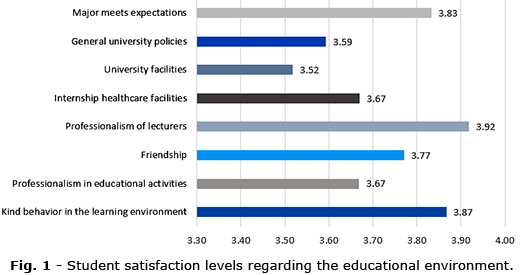
Eight factors related to students’ satisfaction with the educational environment were assessed. The internal consistency of these factors was high (Cronbach’s Alpha = 0.9453), with all item–total correlation coefficients exceeding 0.4. The overall mean satisfaction score was 3.73. Satisfaction with lecturers’ professionalism was the highest (3.92), followed by kindness in the learning environment (3.87), alignment of the major with expectations (3.83), friendships (3.77), quality of internship healthcare facilities (3.67), and professionalism in educational activities (3.67). Satisfaction with university facilities was the lowest (3.52) (Fig. 1).
Satisfaction with the learning environment and students' perceptions of professionalism
All eight satisfaction factors were included in the multivariate regression model. Three factors were independently associated with students’ perceptions of professionalism (table 4). A one-point increase in satisfaction with the chosen major was associated with a 0.141-point increase in the professionalism perception score (β = 0.141, p < 0.001). Similarly, higher satisfaction with the professionalism of lecturers was associated with a 0.140-point increase in the professionalism perception score (β = 0.140, p < 0.001). In addition, higher satisfaction with kind behavior in the learning environment was associated with a 0.179-point increase in the professionalism perception score (β = 0.179, p < 0.001). No significant multicollinearity was detected among the independent variables (VIF = 3.33).
DISCUSSION
The overall average score for students' perceptions of professionalism is 3.94, indicating that students have a relatively good understanding of the factors related to professionalism. Although this score has not reached the maximum level, it reflects a positive awareness and can be considered a solid foundation for future development, provided that students are guided and approached to understand professionalism carefully and systematically.
Personal characteristics and perceptions of professionalism among students
Was observed that the increase in awareness levels with age (p = 0.001) indicates that older students tend to have a better understanding of their professions. This may be attributed to their more extensive life and learning experiences, which help them develop a deeper perspective on professionalism and the demands of the healthcare field. A higher level of awareness among male students (4.04) compared to female students (3.88) (p < 0.001) may reflect differences in approaches and learning experiences. In the study by AlKhater S,(13) in which male students scored significantly higher than female students on the Duty subscale (p = 0.026). Several factors may explain this difference. In some cultural and educational contexts, male students may be more likely to assume leadership roles or express confidence in professional responsibilities, which could contribute to higher self-reported awareness of professionalism. In addition, gender-related differences in self-perception and confidence within the clinical learning environment have been documented in previous studies, where female students may report lower confidence despite demonstrating comparable competencies.(6,14) Cultural and social expectations regarding professional roles in healthcare may therefore influence how students perceive and report their professionalism awareness.
The differences in awareness levels among various academic disciplines (p < 0.001) suggest that students in medical programs (including general practitioners, traditional medicine doctors, dental doctors, preventive medicine doctors, and dental specialists, with a training duration of 6 years) and pharmacy programs (with a training duration of 5 years) may have a clearer understanding of professionalism compared to students in undergraduate programs, such as nursing, midwifery, medical technology, and public health (with a training duration of 4 years). Graduates from medical and pharmacy fields tend to find employment more easily, earn higher salaries, and hold better job positions than those from undergraduate programs.
When evaluating the relationship between study duration and perceptions of professionalism, awareness decreases over the academic years, with the highest level observed in first-year students (p < 0.001). First-year students exhibit greater enthusiasm and motivation as they enter university.(15) However, as they progress further in their studies, the pressures of academic work and professional realities may diminish their interest and understanding of professionalism. Our analysis, along with other studies, indicates that second-year students have the lowest perceptions of professionalism. The second year marks the beginning of practical internships in hospitals and healthcare settings, where real exposure to the hospital environment, illnesses, and the complex relationships among healthcare staff, patients, and students can lead to "disillusionment" regarding their chosen field. This results in the lowest level of professionalism awareness during this period. In subsequent years, as students become more accustomed to the hospital environment, their awareness tends to improve.(15) Similarly, the study by Toan V et al.(6) found that students who had not yet participated in clinical internships had a higher awareness of professional characteristics compared to those who had clinical experience. Internship students likely face real challenges, which can lead to a decrease in their awareness of professionalism.
The influence of family factors indicates that students whose fathers work in healthcare or as public servants have a higher level of awareness (p = 0.011; table 3). This suggests that family background can significantly impact career perception. A father often serves as an ideal role model, shaping a child's awareness, understanding, and behavior regarding various phenomena from an early age.(16) Parents employed in the healthcare sector can foster a supportive environment and inspire students, helping them gain a clearer understanding of the values and requirements in the healthcare field they are pursuing.
Satisfaction with the learning environment and students' perceptions of professionalism
A quick assessment tool to evaluate satisfaction with the educational environment was used, based on the actual conditions observed during the survey, consisting of eight factors (Fig. 1), with an overall average score of 3.73. Generally, students feel satisfied with their learning conditions. The highest satisfaction level pertains to the expertise of the instructors (3.92 out of 5), suggesting that students highly value the knowledge and teaching abilities of their educators. This can contribute to creating a positive learning environment where students feel supported and encouraged to learn. The lowest satisfaction score relates to the university's facilities (3.52 out of 5), highlighting this as an area that requires attention. Facilities impact not only the learning experience but also the health and well-being of students. Improving infrastructure, such as classrooms, learning equipment, and other amenities, could enhance overall student satisfaction. Educational institutions should consider this feedback to develop improvement strategies aimed at enhancing the student learning experience. This result is consistent with other studies in Vietnam.(17,18)
All eight satisfaction factors were included in the multivariable linear regression model, and three factors were independently associated with students’ perceptions of professionalism. Satisfaction with the chosen field of study was positively associated with higher professionalism perception scores (β = 0.141, p < 0.001). Students who feel satisfied with their academic major may be more engaged in their learning process and more attentive to the professional values associated with their discipline (p < 0.001). Contentment with their chosen discipline has a crucial impact on how students perceive professionalism in their area. When students feel satisfied with their field, they tend to feel more confident and motivated to develop themselves, which in turn enhances their understanding of their roles and responsibilities in their profession. Similarly, satisfaction with the professionalism of lecturers was significantly associated with students’ perceptions of professionalism (β = 0.140, p < 0.001). Faculty members are not only knowledge transmitters but also role models for students. When instructors possess solid expertise and teaching abilities, students are more likely to grasp the professional standards and values. Positive interactions with faculty can encourage students to develop their skills and professional attitudes. Positive role modeling by students is considered one of the most effective ways to teach professionalism to medical students.(19) Research by Trivena T et al.(20) concluded that there is a significant impact of faculty professionalism and student motivation on students' academic performance. Additionally, Byszewski's A et al.(21) study indicated that training for faculty can help clinical instructors recognize their influence on students. When students feel satisfied with their relationships with faculty and the learning environment, they tend to be more loyal to the institution, leading to long-term commitment and even making them voluntary ambassadors for the university.(22)
In addition, satisfaction with kind behavior in the learning environment showed the strongest association with professionalism perception (β = 0.179, p < 0.001). This indicates that a friendly and supportive learning environment can profoundly influence how students perceive their roles in the field. Research by Mukhalalati B et al.(23) confirms that the learning environment, such as mentoring programs, reward systems, and measures to address burnout and boredom, supports the development of students' competencies, communication skills, and professional identity. When students feel respected and supported, they are more likely to develop higher self-esteem and responsibility in their careers,(24) which in turn affects their perceptions of professionalism. This underscores the importance of creating a positive learning environment where students are not only equipped with knowledge but also encouraged to develop professional values and attitudes. Educational institutions should focus on improving these factors to enhance the learning experience and career development for students.
Limitations of the study: This study has several limitations that should be acknowledged. First, the cross-sectional design limits the ability to establish causal relationships between the identified factors and professionalism awareness. Second, the use of a self-reported questionnaire may introduce social desirability bias, as students may respond in a manner they perceive as socially acceptable. Third, the study was conducted at a single public university in southern Vietnam, which may limit the generalizability of the findings to other institutions or educational contexts. Despite these limitations, the relatively large sample size provides useful insights into factors associated with professionalism awareness among health science students.
This study assessed health science students' awareness of professionalism and identified factors associated with it. Higher awareness of professionalism was significantly associated with older age, male gender, enrollment in medicine or pharmacy related programs, and having parents who work in healthcare or the civil service. In addition, greater satisfaction with the educational environment - particularly alignment between the chosen major and expectations, perceived faculty expertise, and a supportive learning climate - was strongly associated with higher professionalism awareness. These findings suggest that strengthening professionalism education and fostering supportive learning environments may help promote professional values among health science students.
Awareness of professionalism among health science students is influenced by personal, family, and educational environment factors, highlighting the need to strengthen professionalism education and supportive learning environments.
BIBLIOGRAPHIC REFERENCES
1. American Board of Internal Medicine. Project professionalism. Philadelphia: American Board of Internal Medicine; 2001. [access: 08/03/2026]. Available from: https://medicinainternaucv.wordpress.com/wp-content/uploads/2013/02/project-professionalism.pdf
2. American Board of Family Medicine. ABFM guidelines for professionalism, licensure, and personal conduct [Internet]. ABFM; 2022. [access: 08/03/2026]. Available at: https://www.theabfm.org/professionalism-guidelines/
3. Vietnam Ministry of Health. Decision No.1854/QD-BYT on approving the document “Basic competency standards for general practitioners” [Internet]. Hanoi, Vietnam: Ministry of Health; 2015. [access: 08/03/2026]. Available at: https://thuvienphapluat.vn/van-ban/EN/The-thao-Y-te/Decision-No-1854-QD-BYT-2015-document-about-competence-standards-for-general-practitioners/286613/tieng-anh.aspx
4. Dang NH, Nghia PT, Dung PTV, Thuy TTH. Situation of cosmetic surgery complications treated at the Department of Plastic Surgery, Bach Mai Hospital. J Med Res. 2024;176(3):62-70. DOI:10.52852/tcncyh.v176i3.2300
5. Thai B. Experts list common complications that occur when performing unsafe cosmetic surgery [Internet]. 2024 [access: 08/03/2026]. Available at: https://suckhoedoisong.vn/chuyen-gia-neu-nhung-tai-bien-thuong-xuat-hien-khi-phau-thuat-tham-my-khong-an-toan-169241013101506928.htm
6. Toan VD, Anh LHTQ, Hien HA, Hoa NT, Tuan DQ, Huyen NTT, et al. Survey on perceptions of professionalism in medical practice of medical students at the University of Medicine and Pharmacy, Hue University. J Med Pharm Hue Univ Med Pharm. 2021;11(3):105-110. DOI: 10.34071/jmp.2021.3.14
7. Nhan VT, Violato C, Le An P, Beran TN. Cross-cultural construct validity study of professionalism of Vietnamese medical students. Teach Learn Med. 2014;26(1):72-80. DOI:10.1080/10401334.2013.857333
8. Phan LT, Leksansern A. An application of Career Decision Self-Efficacy Scale-Short Form among Vietnamese medical students. J Educ Health Promot. 2021;10:415. DOI:10.4103/jehp.jehp_307_21
9. Tran TYD, Bui TCP, Nguyen TDH, Pham DUB, Pham LA. Survey on perceptions of core values of professionalism of nursing alumni and students of Eastern International University. Vietnam Med J. 2022;517(2):189-194. DOI: 10.51298/vmj.v517i2.3261
10. Thai TTN, Pham TT, Nguyen KT, Nguyen PM, Derese A. Can a family medicine rotation improve medical students' knowledge, skills and attitude towards primary care in Vietnam? A pre-test-post-test comparison and qualitative survey. Trop Med Int Health. 2020;25(2):264-275. DOI: 10.1111/tmi.13326
11. Thuy TTN, Derese A, Nam TT, Thanh DH, Peersman W. Understanding medical students' interests in family medicine in Vietnam: a qualitative study. Aust J Gen Pract. 2022;51(1-2):68-75. DOI:10.31128/ajgp-02-21-5839
12. Hilton SR, Slotnick HB. Proto-professionalism: how professionalisation occurs across the continuum of medical education. Med Educ. 2005;39(1):58-65. DOI:10.1111/j.1365-2929.2004.02033.x
13. AlKhater SA. Perception of Saudi undergraduate students towards professionalism in medicine. Sultan Qaboos Univ Med J. 2021;21(3):378-385. DOI:10.18295/squmj.4.2021.019
14. Spooner M, Reinhardt C, Strawbridge J, Larkin J, Liew SC, Jafar MH, et al. How cultural factors affect medical students' interactions with clinical practice feedback: a qualitative study of ethnically diverse students at three transcontinental campuses [Internet]. Med Educ Online. 2025;30(1):2567075. DOI: 10.1080/10872981.2025.2567075
15. Almulla MO, Alismail AM, Daraghmeh H. Exploring academic motivation across university years: a mixed-methods study at King Faisal University [Internet]. BMC Psychol. 2025;13(1):1113. DOI: 10.1186/s40359-025-03448-8
16. Cimino S, Tafà M, Cerniglia L. Fathers as key figures shaping the foundations of early childhood development: an exploratory longitudinal study on web-based intervention [Internet]. J Clin Med. 2024;13(23):7167. DOI: 10.3390/jcm13237167
17. Anh NTL, Hien DTT, Thuy DT. Satisfaction with theoretical and clinical learning environment of nursing students at Hai Duong University of Medical Technology. Vietnam Med J. 2024;535(1):110-115. DOI:10.51298/vmj.v535i1.8360
18. Vi HTL, Bich DTN, Thao PT. Survey on satisfaction with clinical learning environment of nursing students at Duy Tan University. Duy Tan Univ J Sci Technol. 2020 [access: 08/03/2026];41(4):128-136. https://files02.duytan.edu.vn/svruploads/dtu-duytan/upload/file/Bai-18.-Ho-Thi-Lan-Vi-51.pdf
19. Bashir A, McTaggart IJ. Importance of faculty role modelling for teaching professionalism to medical students: individual versus institutional responsibility. J Taibah Univ Med Sci. 2022;17(1):112-119. DOI:10.1016/j.jtumed.2021.06.009
20. Trivena T, Harisno H. The effect of lecturer’s professionalism and student’s study interest and motivation on academic achievement of bachelor degree student in online learning in Binus University. Commun Inf Technol J. 2014;8:55-60. DOI:10.21512/commit.v8i2.596
21. Byszewski A, Gill JS, Lochnan H. Socialization to professionalism in medical schools: a Canadian experience. BMC Med Educ. 2015;15:204. DOI:10.1186/s12909-015-0486-z
22. Phuong ND. A study on the impact of student-faculty relationships on brand engagement, student satisfaction and loyalty. State Manag J. 2024 [access: 08/03/2026]32:[aprox. 11 scr.]. Available from: https://www.quanlynhanuoc.vn/2024/12/19/nghien-cuu-anh-huong-moi-quan-he-sinh-vien-giang-vien-doi-voi-gan-ket-thuong-hieu-su-hai-long-va-long-trung-thanh-cua-sinh-vien/
23. Mukhalalati B, Aly A, Yakti O, Elshami S, Daud A, Awaisu A, et al. Examining the perception of undergraduate health professional students of their learning environment, learning experience and professional identity development: a mixed-methods study. BMC Med Educ. 2024;24(1):886. DOI:10.1186/s12909-024-05875-4
24. Gómez-Jorge F, Díaz-Garrido E. The relation between self-esteem and productivity: an analysis in higher education institutions. Front Psychol. 2022;13:1112437. DOI:10.3389/fpsyg.2022.1112437
Acknowledgements
The research team extends their heartfelt gratitude to the leadership and students of Can Tho University of Medicine and Pharmacy for their invaluable support in conducting this survey.
Conflict of Interests
All authors declare no conflicts of interest in this paper.
Financial information
There was no external funding for this research.
Authors Contributions
Conceptualization: Minh Huu Le, Tuyen Thi Hong Nguyen.
Data curation: Tuyen Thi Hong Nguyen.
Formal analysis: Tan Dat Nguyen, Ngoc Huyen Nguyen, Van Trang Do.
Investigation: Lan Thi Kieu Nguyen, Van Leo Le, Minh Trung Chi Nguyen.
Methodology: Minh Huu Le, Tuyen Thi Hong Nguyen.
Supervision: Minh Huu Le, Tan Dat Nguyen.
Writing – original draft: Minh Huu Le, Tan Dat Nguyen, Ngoc Huyen Nguyen, Lan Thi Kieu Nguyen, Leo Van Le, Trung Chi Minh Nguyen, Tuyen Thi Hong Nguyen.
Writing – review & editing: Minh Huu Le, Tan Dat Nguyen, Ngoc Huyen Nguyen, Lan Thi Kieu Nguyen, Leo Van Le, Trung Chi Minh Nguyen, Tuyen Thi Hong Nguyen.
Data availability
The data sets during and /or analysed during the current study are available from the corresponding author on reasonable request.